ollapse generates an outpouring of pyroclastic material down the volcano's slope.[20]
 Deposits near the source vent consist of large volcanic blocks and bombs, with so-called "bread-crust bombs" being especially common. These deeply cracked volcanic chunks form when the exterior of ejected lava cools quickly into a glassy or fine-grained shell, but the inside continues to cool and vesiculate. The center of the fragment expands, cracking the exterior. However the bulk of Vulcanian deposits are fine grained ash. The ash is only moderately dispersed, and its abundance indicates a high degree of fragmentation, the result of high gas contents within the magma. In some cases these have been found to be the result of interaction with meteoric water, suggesting that Vulcanian eruptions are partially hydrovolcanic.[20]
Volcanoes that have exhibited Vulcanian activity include:
 Peléan eruptions (or nuée ardente) are a type of volcanic eruption, named after the volcano Mount Pelée in Martinique,
the site of a massive Peléan eruption in 1902 that is one of the worst
natural disasters in history. In Peléan eruptions, a large amount of
gas, dust, ash, and lava fragments are blown out the volcano's central
crater,[24] driven by the collapse of rhyolite, dacite, and andesite lava dome collapses that often create large eruptive columns. An early sign of a coming eruption is the growth of a so-called Peléan or lava spine, a bulge in the volcano's summit preempting its total collapse.[25] The material collapses upon itself, forming a fast-moving pyroclastic flow[24] (known as a block-and-ash flow)[26] that moves down the side of the mountain at tremendous speeds, often over 150 km (93 mi) per hour. These massive landslides
make Peléan eruptions one of the most dangerous in the world, capable
of tearing through populated areas and causing massive loss of life. The
1902 eruption of Mount Pelée caused tremendous destruction, killing more than 30,000 people and competely destroying the town of St. Pierre, the worst volcanic event in the 20th century.[24]
Peléan eruptions (or nuée ardente) are a type of volcanic eruption, named after the volcano Mount Pelée in Martinique,
the site of a massive Peléan eruption in 1902 that is one of the worst
natural disasters in history. In Peléan eruptions, a large amount of
gas, dust, ash, and lava fragments are blown out the volcano's central
crater,[24] driven by the collapse of rhyolite, dacite, and andesite lava dome collapses that often create large eruptive columns. An early sign of a coming eruption is the growth of a so-called Peléan or lava spine, a bulge in the volcano's summit preempting its total collapse.[25] The material collapses upon itself, forming a fast-moving pyroclastic flow[24] (known as a block-and-ash flow)[26] that moves down the side of the mountain at tremendous speeds, often over 150 km (93 mi) per hour. These massive landslides
make Peléan eruptions one of the most dangerous in the world, capable
of tearing through populated areas and causing massive loss of life. The
1902 eruption of Mount Pelée caused tremendous destruction, killing more than 30,000 people and competely destroying the town of St. Pierre, the worst volcanic event in the 20th century.[24]
Peléan eruptions are characterized most prominently by the incandescent pyroclastic flows that they drive. The mechanics of a Peléan eruption are very similar to that of a Vulcanian eruption, except that in Peléan eruptions the volcano's structure is able to withstand more pressure, hence the eruption occurs as one large explosion rather than several smaller ones.[27]
Volcanoes known to have Peléan activity include:
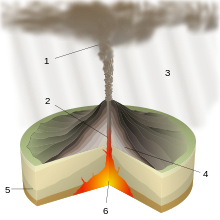 Plinian eruptions (or Vesuvian) are a type of volcanic eruption, named for the historical eruption of Mount Vesuvius in 79 of Mount Vesuvius that buried the Roman towns of Pompeii and Herculaneum and, specifically, for its chronicler Pliny the Younger.[31] The process powering Plinian eruptions starts in the magma chamber, where dissolved volatile gases are stored in the magma. The gases vesiculate and accumulate as they rise through the magma conduit.
These bubbles agglutinate and once they reach a certain size (about 75%
of the total volume of the magma conduit) they explode. The narrow
confines of the conduit force the gases and associated magma up, forming
an eruptive column.
Eruption velocity is controlled by the gas contents of the column, and
low-strength surface rocks commonly crack under the pressure of the
eruption, forming a flared outgoing struct
Plinian eruptions (or Vesuvian) are a type of volcanic eruption, named for the historical eruption of Mount Vesuvius in 79 of Mount Vesuvius that buried the Roman towns of Pompeii and Herculaneum and, specifically, for its chronicler Pliny the Younger.[31] The process powering Plinian eruptions starts in the magma chamber, where dissolved volatile gases are stored in the magma. The gases vesiculate and accumulate as they rise through the magma conduit.
These bubbles agglutinate and once they reach a certain size (about 75%
of the total volume of the magma conduit) they explode. The narrow
confines of the conduit force the gases and associated magma up, forming
an eruptive column.
Eruption velocity is controlled by the gas contents of the column, and
low-strength surface rocks commonly crack under the pressure of the
eruption, forming a flared outgoing struct

Tavurvur in Papua New Guinea erupting.
Volcanoes that have exhibited Vulcanian activity include:
- Sakurajima, Japan has been the site of Vulcanian activity near-continuously since 1955.[22]
- Tavurvur, Papua New Guinea, one of several volcanoes in the Rabaul Caldera.[20]
- Irazú Volcano in Costa Rica exhibited Vulcanian activity in its 1965 eruption.[23]
Peléan
Main article: Peléan eruption

Diagram of Peléan eruption. (key: 1. Ash plume 2. Volcanic ash rain 3. Lava dome 4. Volcanic bomb 5. Pyroclastic flow 6. Layers of lava and ash 7. Stratum 8. Magma conduit 9. Magma chamber 10. Dike) Click for larger version.
Peléan eruptions are characterized most prominently by the incandescent pyroclastic flows that they drive. The mechanics of a Peléan eruption are very similar to that of a Vulcanian eruption, except that in Peléan eruptions the volcano's structure is able to withstand more pressure, hence the eruption occurs as one large explosion rather than several smaller ones.[27]
Volcanoes known to have Peléan activity include:
- Mount Pelée, Martinique. The 1902 eruption of Mount Pelée completely devastated the island, destroying the town of St. Pierre and leaving only 3 survivors.[28] The eruption was directly preceded by lava dome growth.[20]
- Mayon Volcano, the Philippines most active volcano. It has been the site of many different types of eruptions, Peléan included. Approximately 40 ravines radiate from the summit and provide pathways for frequent pyroclastic flows and mudslides to the lowlands below. Mayon's most violent eruption occurred in 1814 and was responsible for over 1200 deaths.[29]
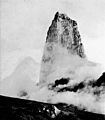
- The 1951 Peléan eruption of Mount Lamington. Prior to this eruption the peak had not even been recognized as a volcano. Over 3,000 people were killed, and it has become a benchmark for studying large Peléan eruptions.[30]
-

-
-
 Mount Lamington following the devastating 1951 eruption.


Plinian
Main article: Plinian eruption

Diagram of a Plinian eruption. (key: 1. Ash plume 2. Magma conduit 3. Volcanic ash rain 4. Layers of lava and ash 5. Stratum 6. Magma chamber) Click for larger version.
0 Comment to "love."
Post a Comment